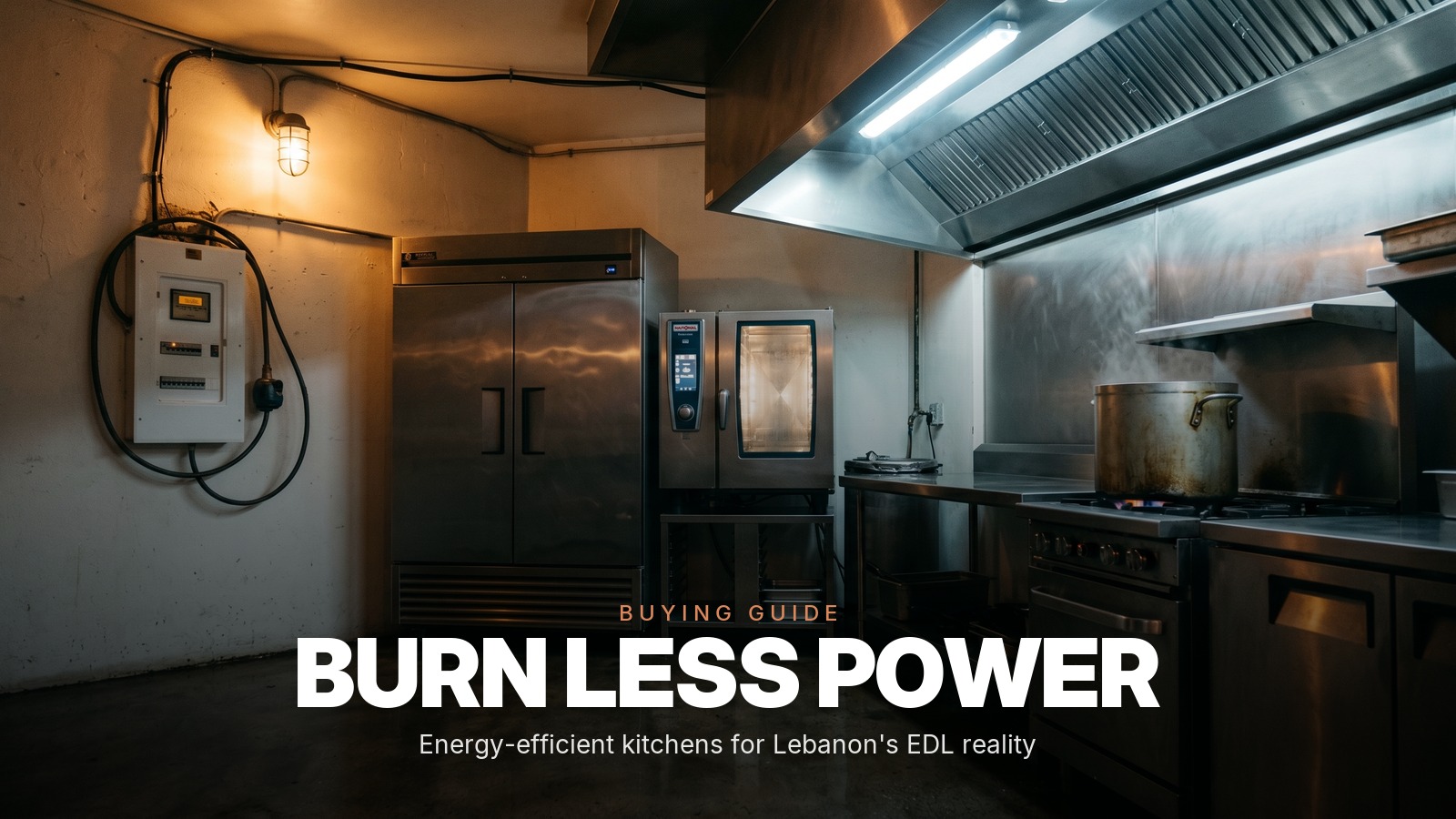
In Lebanon, electricity is no longer just a utility line on your P&L — it's often one of the largest operating expenses a commercial kitchen faces. Between EDL rationing, generator fuel costs, and the unpredictable swing between grid and backup power, every kilowatt-hour counts. For restaurant owners, hotel GMs, and bakery operators, the question isn't whether to reduce energy consumption, but how to do it without compromising service quality or food safety.
After 45 years of outfitting commercial kitchens across Lebanon and the MENA region, we've seen firsthand how the right equipment choices — and the right operating habits — can cut energy bills by 20% to 40%. This guide walks you through the practical, proven strategies that actually move the needle.
Why Energy Efficiency Matters More in Lebanon Than Anywhere Else
In most countries, kitchens run on a single, stable grid. In Lebanon, operators juggle two or three power sources — EDL, private generator subscriptions, and increasingly, solar installations. Each has a different cost per kWh, and generator power can run several times more expensive than grid electricity. That means every inefficient appliance is penalized multiple times over.
An old, oversized freezer that draws 400 watts continuously may cost a few dollars a month on grid power — but when that same freezer runs on generator fuel during an eight-hour rationing window, the cost multiplies dramatically. Multiply that across a full kitchen of refrigeration, cooking, dishwashing, and ventilation equipment, and the financial case for energy efficient kitchen equipment becomes impossible to ignore.
Beyond the bills, there's a quieter benefit: efficient equipment generates less waste heat. That means your HVAC works less, your staff is more comfortable, and your kitchen runs cooler during Lebanese summers when ambient temperatures can push 35°C and above.
Start with Refrigeration — Your Biggest 24/7 Energy Draw
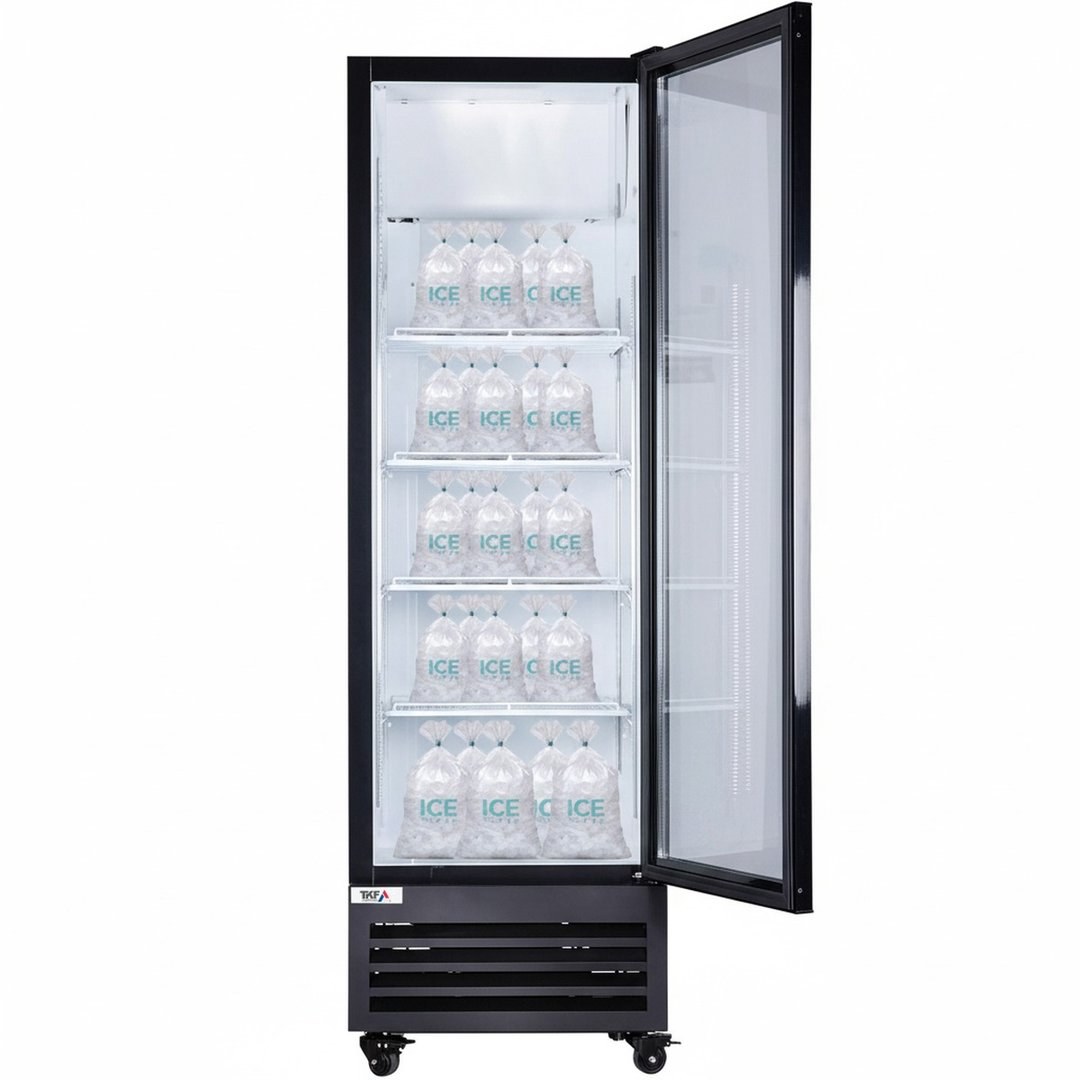
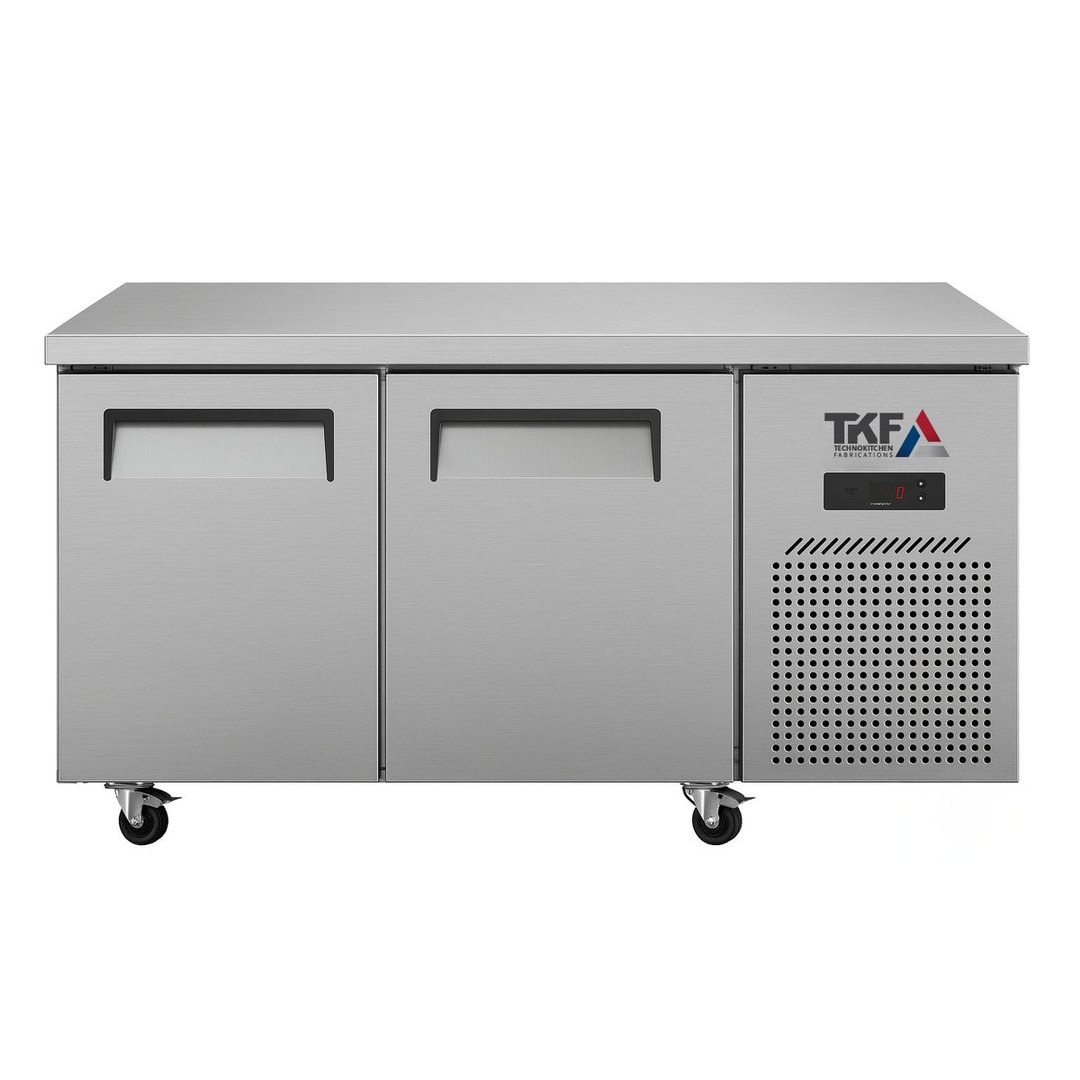
Refrigeration is almost always the largest electricity consumer in a commercial kitchen because it never turns off. A walk-in cooler, reach-in freezer, or blast chiller runs 8,760 hours per year. Even small efficiency gains compound into serious savings.
When specifying new refrigeration, focus on the features that actually drive long-term savings:
- Low-consumption compressors with optimized duty cycles — Modern commercial-grade compressors are engineered to draw less power per cooling cycle and last significantly longer than older designs. Paired with proper condenser sizing, they deliver consistent performance without the complexity of variable-speed electronics.
- High-density polyurethane insulation — Thicker, denser insulation means the compressor cycles less often. Don't cut corners here — insulation quality is one of the biggest differentiators between a cheap unit and a professional one.
- LED interior lighting — Generates less heat inside the cabinet, which means less work for the compressor.
- Self-closing, well-gasketed doors — A worn door gasket can silently add 10-15% to your refrigeration bill. Inspect them quarterly.
- R290 and R600a natural refrigerants — These newer refrigerants are both more efficient and compliant with upcoming F-gas regulations.
A word on inverter technology
Inverter compressors get a lot of marketing attention, and they do offer modulated cooling. But for Lebanese operating conditions, they come with real downsides that operators should weigh carefully. Inverter electronics are sensitive to the voltage fluctuations and frequency instability that are common on generator power and between EDL/generator transitions — spikes can fry the control board, and a single board replacement can cost more than the energy savings of an entire year. Repair availability is also limited locally: when an inverter unit fails, parts often need to be imported, and not every technician is trained to diagnose variable-speed drives. Traditional fixed-speed compressors, paired with quality insulation, tight gaskets, and properly sized condensers, deliver excellent real-world efficiency with far better reliability and serviceability in the Lebanese environment. That's the approach we specify across most of our refrigeration range.
If your current refrigeration is more than 10 years old, replacement often pays back within 18-30 months purely on energy savings. Browse our full range of commercial refrigeration equipment to see our low-consumption, CE-certified models built for Lebanese operating realities.
Choose Cooking Equipment That Heats Fast and Loses Less
Traditional gas ranges and electric hobs waste enormous amounts of energy — much of the heat goes into the kitchen air instead of the food. Modern cooking equipment has largely solved this problem, but only if you specify it correctly.
Induction over open flame, where it makes sense
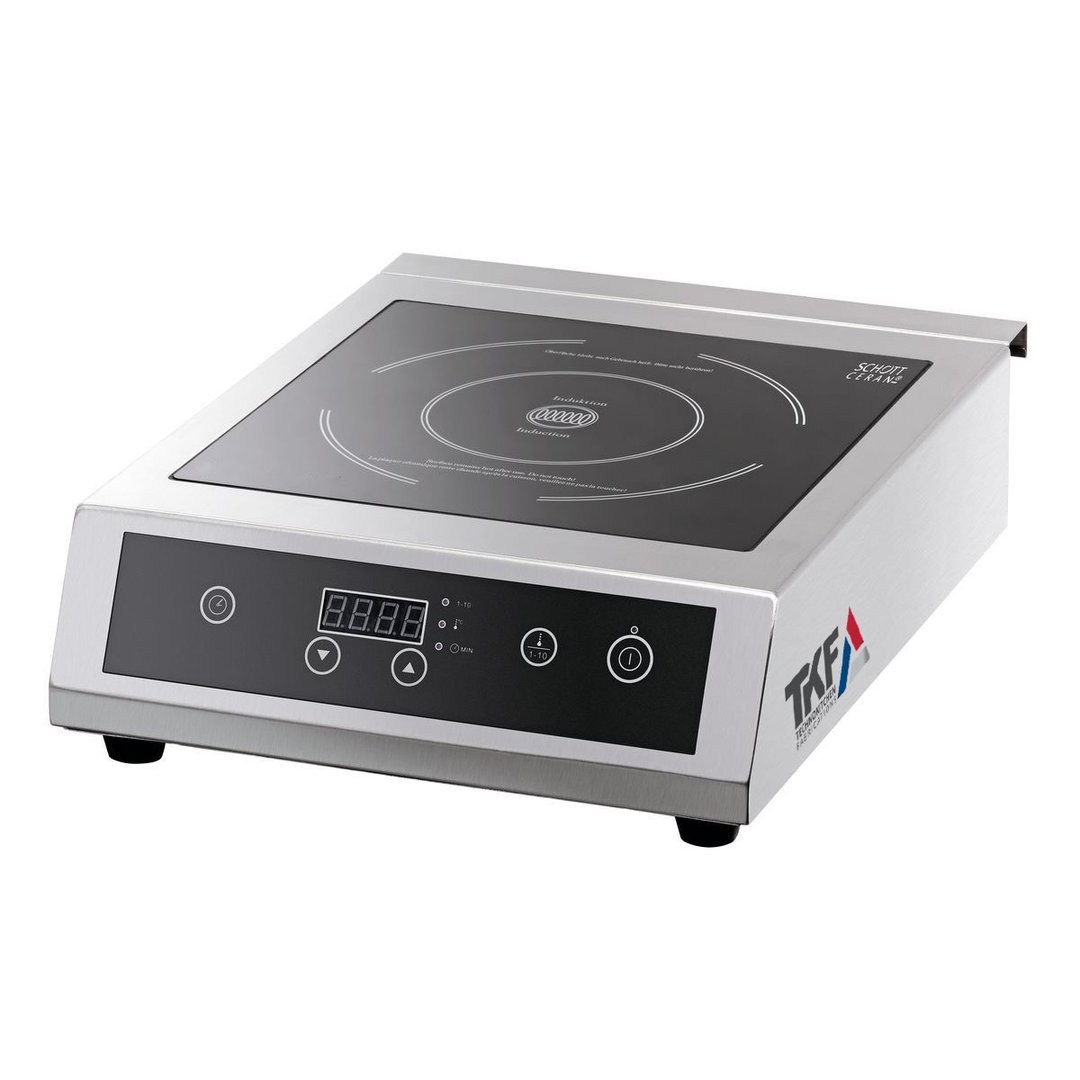
Induction cooktops transfer roughly 85-90% of their energy directly into the pan, compared to 40-55% for gas. They also heat up in seconds, eliminate radiant heat loss, and dramatically reduce the load on your extraction hood — which itself is a major energy consumer. For high-volume pasta stations, sauté lines, and show kitchens, induction is now a strong professional choice.
Combi ovens with boilerless technology
A modern combi oven can replace a conventional oven, a steamer, and sometimes a grill — consolidating three energy draws into one. Boilerless (injection-based) combi ovens use significantly less water and electricity than boiler-based models, and newer units feature automatic cleaning cycles, multi-level cooking, and intelligent energy management. Explore our cooking equipment range for combi ovens from CE-certified European manufacturers.
Right-size everything
The single most common mistake we see is oversized equipment. A six-burner range running a kitchen that only needs four, a 60-liter fryer heating oil for a kitchen that uses 30 — these pay a constant energy tax for capacity you never use. When in doubt, consult with an experienced supplier on proper sizing based on your actual covers per service, not your peak-day ambition.
Schedule Your Equipment Like You Schedule Your Staff
Even the most efficient equipment wastes money if it runs when it doesn't need to. Operational scheduling is the lowest-cost, highest-impact change most kitchens can make — and it costs nothing to implement.
- Stagger startups — Don't fire up every oven, fryer, and griddle at the same time. Bring equipment online 15-30 minutes before you actually need it, in sequence. This also reduces peak demand charges where applicable and eases strain on your generator.
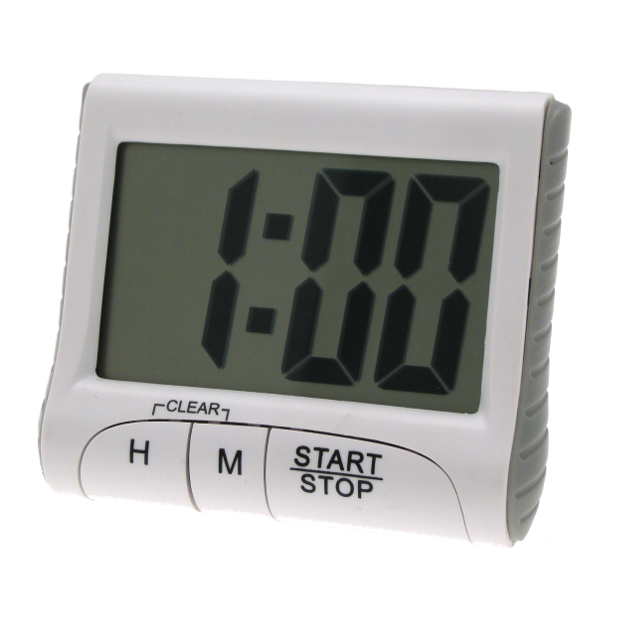
- Use timer-controlled outlets — Coffee machines, display warmers, and prep-line equipment rarely need to run overnight or during closed hours. A simple programmable timer pays back in weeks.
- Set shutdown checklists — Make it part of the closing routine to power down every non-essential appliance. Walk the line. Post a checklist. Audit it weekly.
- Match ventilation to cooking load — Variable-speed hood controls adjust extraction based on actual cooking activity, rather than running at 100% all service. This is one of the highest-ROI upgrades available for any kitchen built before 2015.
- Pre-chill during cheap power windows — Run blast chillers, ice machines, and walk-in pull-downs during grid hours rather than generator hours where your schedule allows.
Look for Energy Star and CE Efficiency Labels
When you're evaluating new equipment, the label matters. Look for:
- Energy Star certification — The U.S. EPA's Energy Star program independently tests and certifies commercial kitchen equipment. Energy Star fryers use around 35% less energy than standard models; dishwashers, 40% less; ovens, 20% less. If it carries the label, it's been measured.
- CE marking — Required for equipment sold in Europe, CE certification guarantees minimum safety and efficiency standards. At IPEC, every unit we distribute is CE-marked — a non-negotiable baseline.
- Energy consumption data on the spec sheet — Reputable manufacturers publish kWh/hour idle and peak figures. Compare them directly between models. If a supplier can't provide this data, that itself tells you something.
Maintenance: The Hidden Efficiency Lever
Efficient equipment that isn't maintained stops being efficient. A clogged condenser coil can increase refrigeration energy use by 30%. A dirty oven seal leaks heat. A scaled-up boiler takes longer to reach temperature. These are invisible costs that accumulate quietly.
Establish a preventive maintenance schedule that covers:
- Monthly cleaning of refrigeration condenser coils
- Quarterly inspection of door gaskets and seals on ovens, combis, and refrigerators
- Annual professional service for combi ovens, dishwashers, and any gas equipment
- Descaling of steam generators, coffee machines, and dishwashers based on local water hardness
IPEC offers professional installation and after-sales service across Lebanon, with trained technicians who understand how to keep your equipment running at peak efficiency. A well-maintained kitchen doesn't just save on electricity — it extends equipment life by years.
FAQ: How Do I Reduce Kitchen Energy Costs Quickly?
If you need a 90-day action plan, here's what delivers the fastest ROI:
- Audit what's running when it shouldn't be. Walk your kitchen at 3 AM. Anything humming that doesn't need to be on is a quick win.
- Replace door gaskets on any refrigeration unit more than 3 years old. Low cost, immediate impact.
- Clean condenser coils on every refrigerator and freezer. Most kitchens have never done this.
- Install timers on coffee machines, bain-maries, and warmers.
- Replace your single worst energy hog — usually the oldest freezer or the oversized fryer — with a modern, low-consumption unit.
These five steps, executed in a quarter, typically cut energy costs by 15-25% with minimal capital outlay.
Build a Kitchen That Pays You Back
Energy efficiency isn't a single purchase — it's a design philosophy. The kitchens that weather Lebanon's energy reality best are the ones designed from the start around low-consumption equipment, smart layout, proper sizing, and disciplined operating habits. Every dollar saved on electricity is a dollar that flows directly to your bottom line, month after month, for the 10-15 year life of your equipment.
If you're planning a new kitchen, renovating an existing one, or simply looking to upgrade your worst energy offenders, our team has spent 45 years helping operators across Lebanon make these decisions. Contact IPEC today for a consultation, equipment audit, or quote — and let's build you a kitchen that works as hard on efficiency as you do on service.